

 Türkçe
  English
  Русский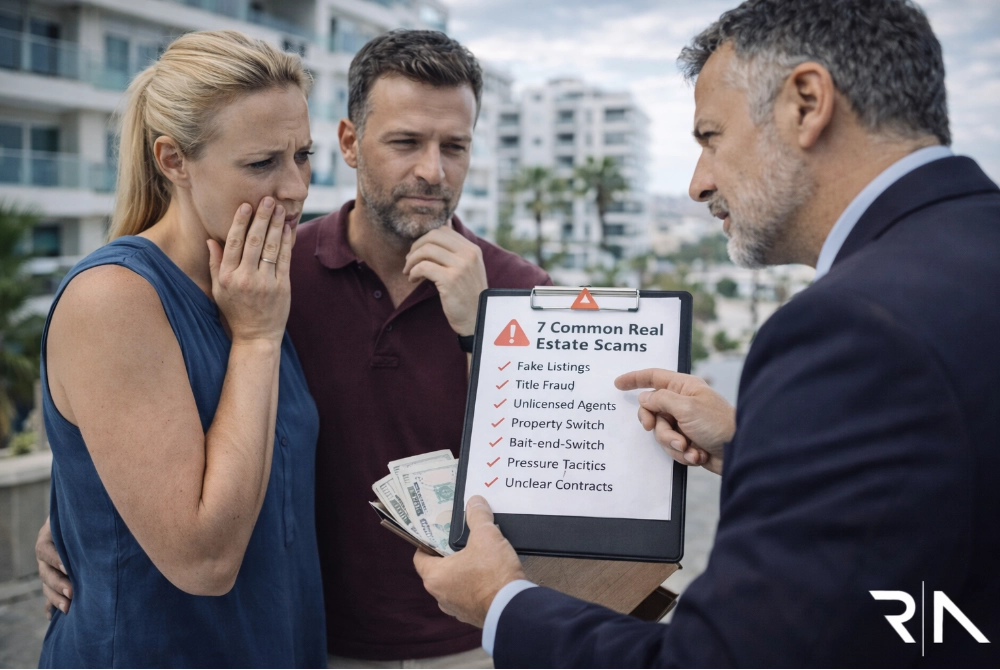
Real estate fraud targeting foreign buyers in Turkey is a documented and persistent problem. From forged title deeds and fake powers of attorney to off-plan construction scams and citizenship-by-investment fraud schemes, the risks are real — and the financial consequences can be devastating. In 2025 alone, Turkish authorities launched revocation proceedings against 451 investors who obtained citizenship through fraudulent property transactions, marking the largest enforcement action in the programme's history.
This guide identifies the seven most common real estate scams affecting foreign property buyers in Turkey, explains how each scheme works, and provides actionable legal protection measures for every stage of the purchasing process. Whether you are buying a holiday apartment in Antalya or a commercial property for investment, understanding these risks before you commit is your most effective defence.
Why Foreign Buyers Are Targeted
Real estate fraud in Turkey disproportionately affects foreign buyers for several structural reasons. Foreign nationals are typically unfamiliar with Turkish property law, cannot read Turkish-language legal documents, may not understand the role of the Land Registry system, and often rely entirely on estate agents or intermediaries whose interests may not align with the buyer's.
In Antalya — Turkey's second most active market for foreign property transactions — the combination of high demand, language barriers, and significant transaction values creates an environment where fraudsters can operate with relative ease. The Turkish Land Registry system itself is robust and well-regulated; the vulnerabilities lie in the steps before official registration, where fraudulent documents, misrepresentation, and pressure tactics are most commonly deployed.
The critical point to understand is this: once a property transaction is registered at the Land Registry Office, it carries strong legal protection. The danger exists in the period before registration — during property selection, contract negotiation, and payment — when foreign buyers are most vulnerable to deception.
Scam #1: Forged Title Deeds (Sahte Tapu)
Document forgery is defined as the creation of fraudulent official documents — including title deeds, valuation reports, or notary attestations — with the intent to deceive a buyer into completing a property transaction based on false information. As of 2025, forged documents in Turkey have become increasingly sophisticated and difficult to detect without professional verification through the Land Registry.
How This Scam Works
The fraudster presents a forged title deed (Tapu Senedi) that appears authentic, often featuring copied official seals and registration numbers from real properties. The buyer, unable to read Turkish and relying on the visual appearance of the document, signs a preliminary contract and pays a deposit — sometimes the full purchase price. When the buyer later attempts to register the transfer at the Land Registry Office in Antalya, the fraud is discovered: the document is fake, and the seller has disappeared with the funds.
How to Protect Yourself
Never accept a title deed at face value. Before any payment, your lawyer must verify the document directly with the Land Registry (Tapu ve Kadastro Mudurlugu). This verification confirms whether the title deed number exists, whether the property details match, and whether the person presenting the deed is the registered owner. This single step would prevent the vast majority of title deed fraud cases in Antalya and across Turkey.
Scam #2: Owner Impersonation and Fake Power of Attorney
Owner impersonation fraud occurs when a person falsely represents themselves as the registered owner of a property, or presents a forged power of attorney (vekaletname) purporting to authorise them to sell the property on the owner's behalf. This scam specifically targets properties with absentee owners, deceased owners whose records have not been updated, or foreign owners who are not physically present in Turkey.
How This Scam Works
The fraudster identifies a property whose owner is absent — often a diaspora Turk living abroad, or a deceased person whose heirs have not yet transferred the title. Using stolen or fabricated identity documents, the fraudster visits a notary in Antalya (or another city to avoid local detection), obtains a power of attorney, and proceeds to sell the property to an unsuspecting foreign buyer. The real owner typically discovers the fraud months later when property tax notices or utility bills arrive at unexpected addresses.
How to Protect Yourself
Always verify the seller's identity independently. If a power of attorney is involved, your lawyer must verify its authenticity directly with the issuing notary. Turkish notary records are centralised and verifiable. Additionally, check the property's registration history at the Land Registry for any recent or suspicious changes in ownership or annotations.
Scam #3: Multiple Sales of the Same Property
Multiple sales fraud involves an agent or purported owner selling the same property to two or more buyers simultaneously, collecting deposits or full payment from each before disappearing. This type of fraud particularly affects off-plan developments and vacation properties in coastal regions of Turkey, including Antalya.
How This Scam Works
The fraudster — often posing as an estate agent or developer representative — shows the same property to multiple prospective buyers, typically from different countries. Each buyer signs a preliminary sales contract and pays a substantial deposit. Since preliminary contracts are not registered at the Land Registry, none of the buyers are aware of the others. The fraudster collects multiple deposits and vanishes. When the buyers eventually attempt to register their purchases, they discover competing claims on the same property.
Turkish Court of Cassation (Yargitay), 15th Criminal Chamber, 2022/8934 E., 2023/4521 K."The act of selling the same immovable property to multiple buyers through separate preliminary contracts, with the intent to obtain payment from each without the ability or intention to perform, constitutes the offence of qualified fraud (nitelikli dolandiricilik) under Article 158 of the Turkish Penal Code, carrying a sentence of three to ten years' imprisonment."
How to Protect Yourself
Before paying any deposit, obtain an up-to-date encumbrance report (Takyidat Belgesi) from the Land Registry. This document reveals any existing claims, annotations, or pending transactions on the property. If another buyer's preliminary contract has been registered as an annotation, it will appear in this report. For additional protection, your lawyer in Antalya can register your own preliminary contract as an annotation at the Land Registry — creating a public record of your claim.
Scam #4: Missing Habitation Certificate (Iskan Sorunu)
The habitation certificate (Iskan Belgesi) is defined as an official document issued by the municipality confirming that a building has been completed in accordance with the approved construction plans and is legally suitable for residential occupation. The absence of this certificate is one of the most widespread and costly problems affecting foreign property buyers in Antalya.
How This Scam Works
Unlike the previous scams, missing habitation certificates often do not involve intentional fraud by the seller. Many developers in Antalya's coastal areas construct buildings but fail to obtain the habitation certificate from the municipality — sometimes due to deviations from approved plans, sometimes due to incomplete documentation, and sometimes simply due to negligence. The property is sold as "ready to move in," and the buyer may occupy it for years before discovering the problem.
Without an Iskan certificate, the building technically does not legally exist as a residential space. The consequences are severe: difficulty connecting or maintaining utility services (water, electricity, natural gas), inability to obtain building insurance, significant obstacles to reselling the property, potential demolition orders if the building violates zoning regulations, and reduced property value.
How to Protect Yourself
Demand written proof of the habitation certificate before making any payment. Your lawyer should verify the certificate's validity directly with the relevant municipality in Antalya. Do not accept verbal assurances that "the Iskan is being processed" or "will be obtained soon" — these claims frequently prove false, and you will own a property with a permanent legal defect.
Scam #5: Off-Plan Construction Fraud
Off-plan construction fraud occurs when a developer sells properties in a building that has not yet been completed — and may never be completed. The developer collects instalment payments from multiple foreign buyers based on attractive architectural renderings and promises of delivery, then halts construction, diverts the funds, or disappears entirely.
How This Scam Works
A developer markets a new residential complex in Antalya with professional brochures, a model apartment, and an attractive payment plan. Foreign buyers sign contracts and begin making instalment payments. Months or years pass with little visible progress. The developer provides excuses — permit delays, supply chain problems, seasonal weather. Eventually, construction stops. The buyers discover that the land was never properly zoned for residential development, the developer has no construction licence, or the funds have been used for other projects.
A Russian buyer purchased an off-plan apartment in Antalya, paying in instalments over twelve months. After a year, no construction had taken place. Upon investigation, it was discovered that the land had never been zoned for residential development, the project had never received municipal approval, and the developer had no assets to recover. The buyer's investment was a total loss.
How to Protect Yourself
Before investing in off-plan property, your lawyer must verify: the developer's construction licence (Insaat Ruhsati), the land's zoning status with the municipality, the developer's financial standing and track record, and whether the land has any encumbrances. Payment should be structured in stages tied to verifiable construction milestones, never as a lump sum upfront. In Antalya, always confirm that the project has received all necessary municipal approvals before committing any funds.
Scam #6: Citizenship-by-Investment Fraud
Citizenship-by-investment fraud is a scheme where sellers, intermediaries, or agents manipulate the transaction to make a property appear to meet the $400,000 USD minimum threshold for Turkish citizenship — when in reality, it does not. This includes cash-back arrangements, inflated appraisals, and fictitious sales.
How This Scam Works
The most common variant involves a cash-back arrangement: the buyer pays $400,000 officially through the banking system, and the seller secretly refunds $50,000 to $150,000 in cash after the title deed transfer. The property's actual value may be only $250,000, but the paperwork shows $400,000. In some cases, SPK appraisers are complicit, producing deliberately inflated valuation reports.
In 2025, Turkish authorities uncovered a large-scale network operating through these methods. Revocation proceedings were initiated against 451 investors, and dozens of suspects — including real estate agents, appraisers, and intermediaries — were arrested. As of January 2026, authorities report that fictitious sales and inflated valuations have re-emerged at a lower but persistent level despite the crackdown.
| Red Flag | What It Means | Your Response |
|---|---|---|
| Seller offers cash back after transfer | The property does not meet the $400,000 threshold | Refuse immediately; report to authorities |
| Agent suggests you can "skip" the official appraisal | Possible plan to use a complicit or fake appraiser | Insist on an independent SPK-licensed valuation |
| Property price is significantly above comparable sales | Price may be inflated specifically for citizenship buyers | Commission your own independent market comparison |
| Agent pressures you to complete quickly | Designed to prevent you from conducting due diligence | Slow down; engage independent legal counsel |
| Payment instructions include offshore or third-party accounts | Funds may not go to the actual seller | Pay only through official Turkish bank channels directly to the seller |
How to Protect Yourself
Work with an independent citizenship lawyer — not one recommended by the seller or estate agent. Your lawyer should commission the SPK valuation independently, verify the property's market value against comparable sales, ensure all three values (bank transfer, appraisal, and declared amount) genuinely meet the $400,000 threshold, and confirm that the transaction involves no side agreements, cash-back arrangements, or hidden discounts.
Scam #7: Undisclosed Encumbrances and Hidden Debts
An encumbrance is defined as any claim, lien, mortgage, seizure order, or legal restriction registered against a property that limits the owner's right to freely sell or transfer it. Hidden encumbrances represent one of the most common risks for foreign buyers in Turkey, because the buyer inherits the debt upon taking ownership.
How This Scam Works
The seller presents the property as unencumbered and free of debt. The buyer, trusting the seller's assurances, proceeds with the purchase without obtaining an independent encumbrance report. After the title deed transfer, the buyer discovers existing mortgages (ipotek), tax liens, court-ordered seizures, or third-party claims on the property. Under Turkish law, registered encumbrances follow the property — not the person — meaning the new owner is now legally responsible for the outstanding debts.
How to Protect Yourself
The encumbrance report (Takyidat Belgesi) is your most important single document in any Turkish property transaction. This report is obtained from the Land Registry and provides a complete record of all registered claims against the property. Your lawyer in Antalya must obtain and review this report before any payment is made. A clean Takyidat Belgesi, combined with a current title deed verification, provides strong assurance that the property can be transferred free of hidden liabilities.
Your Complete Protection Checklist
The following table summarises the essential protective measures for each stage of the property purchasing process. Completing every step on this checklist does not guarantee a risk-free transaction, but it eliminates the vast majority of fraud scenarios that affect foreign buyers in Antalya and throughout Turkey.
| Stage | Protective Action | Who Handles It |
|---|---|---|
| Before viewing | Engage an independent property lawyer — not one recommended by the agent or seller | Buyer |
| Before any payment | Title deed verification directly with Land Registry | Lawyer |
| Before any payment | Encumbrance report (Takyidat Belgesi) | Lawyer |
| Before any payment | Habitation certificate (Iskan) verification with municipality | Lawyer |
| Before any payment | Seller identity verification (or power of attorney verification with issuing notary) | Lawyer |
| Before contract signing | Zoning status confirmation with municipality | Lawyer |
| Before contract signing | Independent legal review of all contracts | Lawyer |
| Payment stage | Transfer funds only through official Turkish bank channels, only to verified seller account | Buyer + Lawyer |
| Title deed transfer | Sworn translator and lawyer present at Land Registry | Lawyer arranges |
| Post-purchase | Utility transfers, insurance, and property tax registration | Lawyer or buyer |
Never sign a contract, pay a deposit, or transfer any funds without an independent legal review by a lawyer you personally selected and retained. The cost of legal representation is a fraction of the potential loss from any of the scams described in this guide. In Antalya's competitive property market, pressure to "act fast" is the single most reliable indicator that something is wrong.
Frequently Asked Questions About Real Estate Scams in Turkey
What is the most common property scam targeting foreigners in Turkey?
The most common fraud involves properties sold without a valid habitation certificate (Iskan), followed by forged title deeds and undisclosed encumbrances. These three categories account for the majority of cases where foreign buyers suffer financial loss. All are preventable through proper legal due diligence before any payment is made.
Is the Turkish Land Registry system reliable?
Yes. The Turkish Land Registry (Tapu ve Kadastro Mudurlugu) is a centralised, government-operated system that provides strong legal protection for registered property rights. The fraud risks described in this guide occur primarily before official registration — during the pre-contract and payment stages. Once a transaction is properly recorded at the Land Registry, the buyer's ownership rights are legally protected.
Can I recover my money if I am scammed?
Recovery depends on the nature of the fraud and whether the perpetrator can be identified and located. Turkish criminal law classifies real estate fraud as qualified fraud (nitelikli dolandiricilik) under Article 158 of the Turkish Penal Code, carrying sentences of three to ten years. Civil recovery is possible through a lawsuit, but if the fraudster has no assets, practical recovery may be limited. Prevention through proper due diligence is far more effective than attempting recovery after the fact.
How do I verify if a title deed is genuine?
A title deed can only be reliably verified through direct inquiry with the Land Registry Office where the property is registered. Your lawyer submits the title deed details and receives official confirmation of the property's registration status, current owner, and any annotations. Visual inspection of the document alone is insufficient, as modern forgeries can be highly convincing.
Should I use the estate agent's recommended lawyer?
No. You should always retain a lawyer independently. A lawyer recommended by the seller or estate agent may have a financial relationship with those parties, creating a conflict of interest. Your lawyer's sole obligation should be to protect your interests. This is one of the most important decisions you will make in the property buying process.
What is a Takyidat Belgesi and why is it important?
A Takyidat Belgesi (encumbrance report) is an official document obtained from the Land Registry that lists all claims, liens, mortgages, seizure orders, and other restrictions registered against a specific property. It is the single most important due diligence document in any Turkish property transaction, because it reveals hidden debts or legal claims that the buyer would inherit upon purchase.
Are off-plan property purchases safe in Turkey?
Off-plan purchases carry inherently higher risk than buying completed properties with existing title deeds. However, they can be conducted safely if the developer's construction licence, the land's zoning status, and the developer's financial standing are independently verified by a qualified lawyer before any payment. Payment should be structured in stages tied to construction milestones, never as a single upfront sum.
Fraud prevention is inseparable from the broader legal framework foreign buyers need to navigate in Antalya. For the full buying workflow — tax number, due diligence, title deed procedures, citizenship thresholds and cost tables — read our complete 2026 guide to buying property in Antalya as a foreigner.
Every single scam in this article shares one defence: independent legal counsel retained before payment. Our dedicated article on whether you need a lawyer to buy property in Antalya as a foreigner explains exactly what an independent property lawyer checks, negotiates and prevents — and why the estate agent's "recommended" lawyer is never independent.
For the master reference that ties fraud prevention, due diligence, title deed procedure and post-purchase compliance together, return to the definitive Antalya foreign-buyer guide.